The Visual Language of a Fashion Narrative
When an audience watches a runway collection march down the catwalk, what evokes an immediate emotional gasp? It is rarely the technical stitch count or the hem finish. The first instantaneous emotional impression is created by the cohesive color palette and overarching visual mood. Color communicates mood, season, cultural symbolism, and brand personality faster than any other design element.
1. The Applied Color Wheel for Fashion Designers
Understanding color theory goes far beyond elementary art class. Couturiers use harmonious color relationships to balance complex collections:
- Monochromatic Harmonies: Utilizing varying tints, shades, and tones of a single hue (e.g., champagne, camel, terracotta, and espresso brown). This creates an ultra-luxurious, elongated, and sophisticated aesthetic.
- Analogous Palettes: Pairing colors that sit adjacent on the color wheel (e.g., emerald green, peacock teal, and royal blue). This yields rich, natural, and visually soothing combinations.
- Complementary & Split-Complementary Contrasts: High-impact pairings across the wheel (e.g., deep burgundy and sage green, or saffron gold and midnight indigo). Perfect for statement festive wear and runway showstoppers.
- Warm vs. Cool Undertone Calibration: Aligning fabric dyes with Indian skin undertones (golden olive, warm peach, deep honey) to ensure the wearer looks radiant.
"A runway collection without a rigorous color story is like a symphony where every instrument plays a different song at the same time. Color is the melody that binds your entire collection into one unforgettable memory." — SIF Design Faculty
2. The Anatomy of a Professional Mood Board
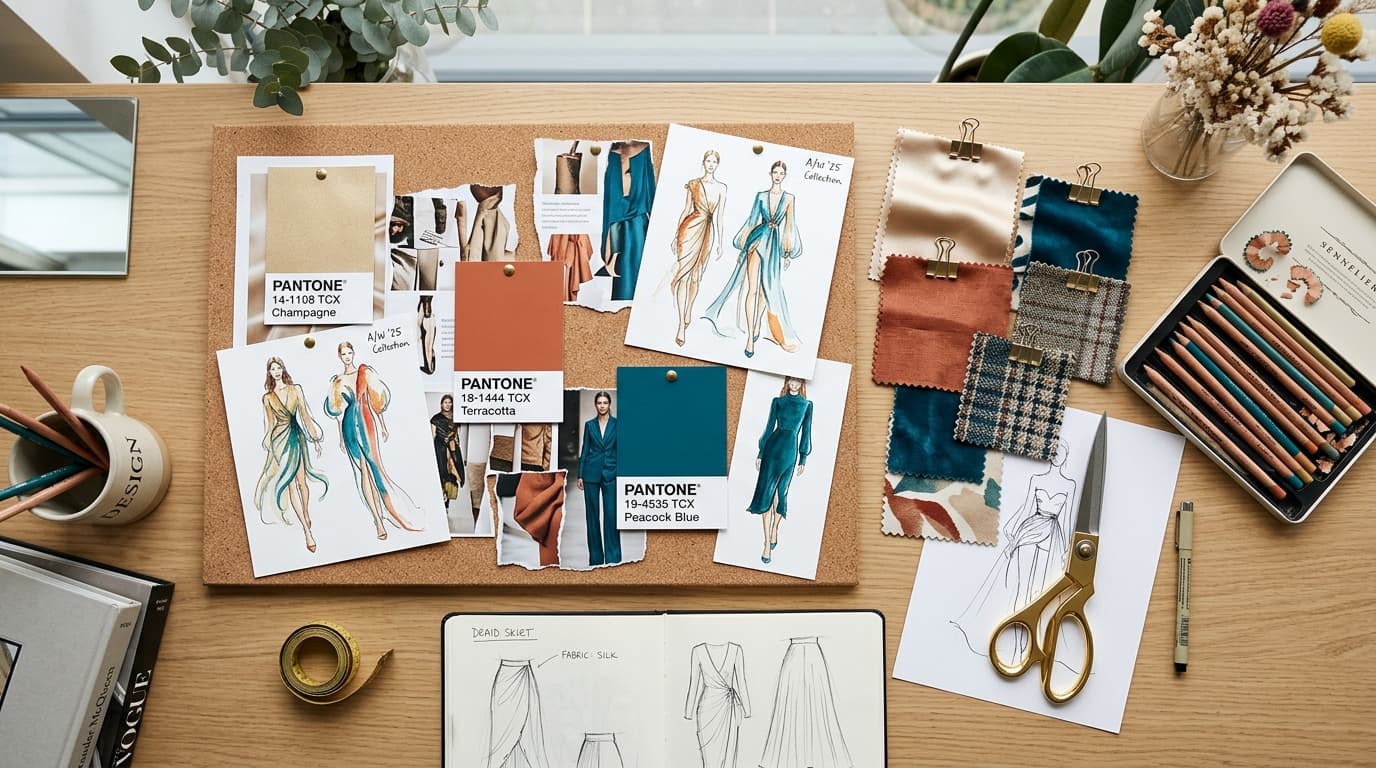
A mood board is not simply a random collage of pretty Pinterest pictures. A professional fashion mood board is a rigorous creative roadmap containing:
- Primary Concept & Muse: Clear visual anchor depicting the central inspiration (e.g., Mughal architecture, brutalist concrete forms, coastal sea foam, or 1970s Bollywood cinema).
- Physical Fabric Swatches: Actual tactile samples of velvet, raw silk, tulle, and organza to demonstrate texture contrasts.
- Pantone Color Chips: Exact color reference codes specifying the primary 60% base tone, 30% secondary hue, and 10% high-voltage accent pop.
- Silhouette Sketches (Croquis): Initial line art demonstrating how volumes, shoulders, and lengths will evolve across 12 to 24 runway looks.